History Is More Interesting When You Can Follow the Threads
If you love history, you probably already know the feeling.
You start by looking up one person, one event, or one place. Maybe you want to remember when Frida Kahlo was born. Maybe you’re curious about the history of the Chicago Cubs. Maybe you suddenly wonder what Albert Einstein was doing before he became one of the most famous scientists in history.
And then, one question leads to another.
Who did they know? Where did they live? What was happening around them? What happened before that? What happened next?
That is the kind of historical exploration that inspired Histolines.
Histolines is built around a simple idea: history makes more sense when you can see it unfold over time.
Instead of treating history as a collection of isolated facts, Histolines lets you explore people, places, events, photographs, quotes, collections, and dates as parts of a much larger timeline.
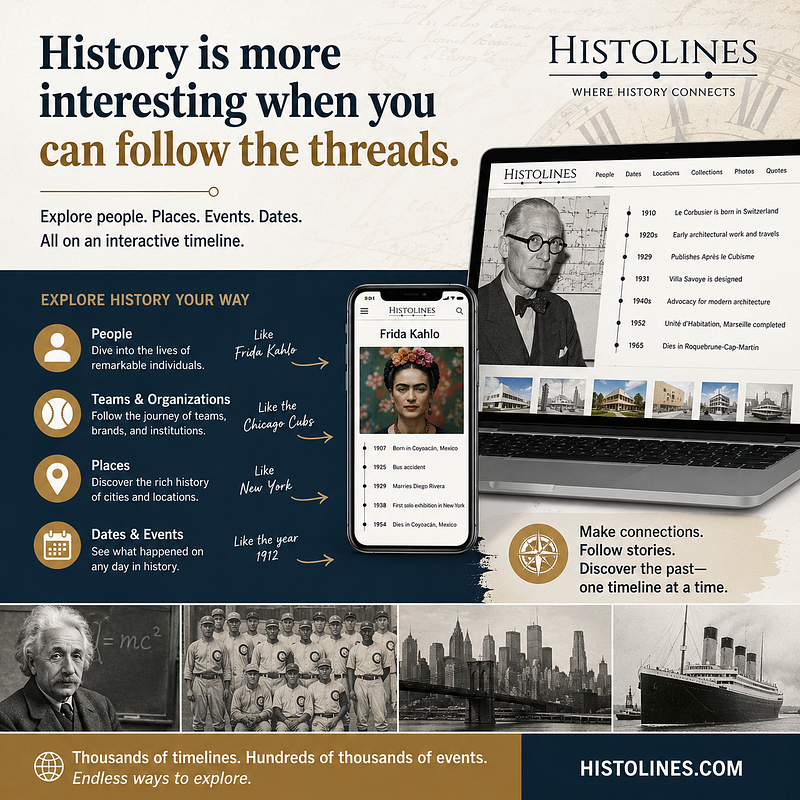
Start With a Person. See Where History Takes You.
One of the easiest ways to explore Histolines is to start with a person.
Take Frida Kahlo, for example.
Frida Kahlo’s Historical Timeline on Histolines
Her timeline begins with her birth in 1907 and then follows events throughout her life. You can see her education, her early jobs, the 1925 accident that profoundly changed her life, her involvement with the Mexican Communist Party, her meeting with Diego Rivera, her marriage, her move to Cuernavaca, and eventually her exhibitions in New York. (Histolines)
But the interesting part isn’t simply knowing those dates.
It’s seeing them next to each other.
A biography normally tells you what happened. A timeline lets you start asking why did it happen then?
You can see how different parts of a person’s life overlap: family, career, travel, relationships, politics, accidents, achievements, and historical events.
Suddenly, a biography becomes a story you can explore rather than a page you simply read.
History Isn’t Just About People
One of the things I like about Histolines is that a timeline doesn’t have to belong to a person.
Consider the Chicago Cubs.
Chicago Cubs Historical Timeline on Histolines
The Cubs’ timeline starts in 1876, when William Hulbert established the team as the Chicago White Stockings. It follows ownership changes, pennants, and important moments in the team’s history. The timeline also includes photographs and historical context — for example, the remarkable 1906 Cubs season and the back-to-back World Series championships of 1907 and 1908. (Histolines)
This is a great example of why historical timelines don’t have to be confined to traditional subjects.
A baseball team has a history.
So does a city.
So does a company.
So does a political movement.
So does a family.
So does a building, a technology, or a cultural phenomenon.
Once you start thinking about history this way, almost everything becomes a potential historical timeline.
Follow Einstein From Childhood to the Patent Office
Another fascinating example is Albert Einstein.
Albert Einstein’s Historical Timeline on Histolines
Instead of jumping directly to the famous scientist associated with relativity, you can follow the earlier parts of his life.
The timeline includes his childhood, his schooling in Munich, his move to Italy, his studies at ETH, his meeting with Mileva Marić, his graduation, and his early adulthood. It eventually reaches 1905 and his work on the Special Theory of Relativity. (Histolines)
That makes the timeline particularly useful for something historians do all the time: putting famous moments back into context.
We tend to remember Einstein as “Einstein.”
But before the famous photograph, the theories, and the Nobel Prize, there was a child, a student, a young man, a husband, a father, a Swiss citizen, and an employee at the patent office.
History becomes much more interesting when you see the person who existed before the historical figure we already know.
Try Exploring a Place Instead
What if you’re more interested in cities than individuals?
Histolines can take you in that direction too.
Take New York.
New York’s Historical Timeline on Histolines
Its timeline brings together events associated with the city across centuries. You can encounter old maps and photographs alongside people who moved to New York, visitors who passed through, musicians, politicians, and major cultural moments. The timeline includes, for example, Bob Dylan arriving in New York in 1961 and The Beatles arriving in 1964. (Histolines)
This is where the idea of a historical timeline becomes particularly powerful.
You aren’t necessarily asking:
“What happened in New York?”
You can instead ask:
“Who was passing through New York at this particular moment in history?”
That’s a very different way to discover the past.
You Can Even Explore a Single Year
Another way to browse Histolines is by date.
Instead of starting with a person or place, start with a year.
For example, look at 1912.
Histolines’ 1912 Historical Timeline
You’ll find the Titanic, but you’ll also find much more.
The RMS Titanic departed Southampton in April and sank on April 15. But around those events are photographs, inventions, sporting events, writers, artists, explorers, musicians, cities, and people whose lives intersect with that particular year. (Histolines)
This is one of my favorite ways to think about browsing history.
Pick a year and see what the world looked like.
You might begin with the Titanic and end up reading about Machu Picchu, photography, baseball, aviation, or a person you’ve never heard of before.
That’s the fun of historical discovery.
History Has Connections
Traditional history is often presented in categories.
Art.
Politics.
Science.
Sports.
War.
Music.
Geography.
Biography.
But real history doesn’t stay inside those categories.
Frida Kahlo’s life intersects with Mexican politics, art, Diego Rivera, travel, medicine, and the cultural history of Mexico.
The Chicago Cubs connect sports with Chicago, business, culture, architecture, journalism, and generations of fans.
Einstein’s life connects science with education, immigration, family, politics, and the dramatic changes of the early twentieth century.
New York connects thousands of individual stories together.
And a single year can contain an astonishing mixture of unrelated events that suddenly become interesting when you see them on the same timeline.
That’s the idea behind Histolines.
A Different Way to Discover History
Histolines isn’t meant to replace books, museums, archives, or historians.
Think of it more like a map for getting curious.
You might arrive looking for Frida Kahlo.
Then you discover Diego Rivera.
Then Mexican history.
Then the Mexican Communist Party.
Then another artist.
Then an exhibition in New York.
And suddenly you’ve spent an hour following connections you never planned to explore.
That’s what makes an interactive timeline different from a traditional encyclopedia.
An encyclopedia answers a question.
A timeline can give you your next question.
Explore by Person, Place, Date — or Just Follow Your Curiosity
Histolines organizes historical information in several different ways.
You can explore timelines of people and other historical subjects, browse events by date, explore historical locations, and discover collections that group related events together. Histolines also has a family-timeline feature designed to connect the histories of multiple people into one narrative. (Histolines)
And importantly, Histolines is designed to be participatory.
Users can add events, photos, and quotes, while existing posts can be updated and refined. The project combines user contributions with large-scale historical data collection and processing. (Histolines)
That means the timeline isn’t supposed to be a finished monument to history.
It’s something that can keep growing.
So, Where Will You Start?
If you enjoy history, don’t think of Histolines as a site where you have to know exactly what you’re looking for.
Try the opposite.
Start with a name you’ve always been curious about.
Pick a city.
Choose a year.
Look at a historical collection.
Or follow one interesting event and see where it leads.
You may start with Frida Kahlo and end up somewhere completely unexpected.
And that’s the point.
History isn’t just a list of things that happened. It’s a giant network of people, places, ideas, accidents, discoveries, decisions, and coincidences.
Histolines gives you a way to wander through that network.
Pick a thread. Follow it through time. See where history takes you.


Comments
Post a Comment